1.What role does the individual play
in the fight against poverty?
Poverty has been a
problem to human lives for so many years. Some factors of poverty are
human-made while others are not. There aretwo
kinds of poverty: deserved poverty and non-deserved poverty (Hartford, 2013).
Hartford, the writer of “Roots of Poverty” says, “The deserving poor include
orphans, accident victims, those with a debilitating illness, etc. for whom we
should provide some ameliorative charity.”
The least thing you can
do to curb poverty is not you to be a burden to society. Instead, you haveto strive towork harder.Just depending on someone else, due to
laziness, alcoholism and drug abuse can cause you to be a poor person. In that
circumstance, the person falls into the category of the undeserving poverty. In
other words, if the person works hard, he/she can become a self-sufficient
person.
2.How do different social variables (e.g.,
race, class, and gender) impact poverty rates?
Discrimination and
oppression against some races, religion or gender play a pivotal role in
creating poverty in the society.
According to T.J. Sullivan(2016),
"after the abolition of slavery, for example, African Americans
experienced decades of severe oppression during which it was difficult for
black families to advance from poverty." This, however, shows that some formof poverty in society is human-made and can be
overcome with struggle and support from the whole community, regardless of
race, gender, and ethnicity.
This letter is to raise the issue of drug and
alcohol abuse among our society which has been a social problem for a long
time. In modern societies, drug and alcohol abuse have become very common, such
that it has become an epidemic that affects the community as a whole. It all
starts when the person uses overdose drugs or consumes a lot of alcohol every
day. If measures are not put in place, it could cause a lot of health problems.
There are many factors that influence people in the drug and
alcohol abuse. These factors include the biological make-up of the person
(genetics), conditions at home, school or neighborhood influences and a
person's developmental stage (CDC, 2017).Also, the environment can be a major factor in influencing drug and
alcohol abuse. For example, if the child grows up in an environment where elderly
people have no limits in using drugs and alcohol, then the child can see this
as a normal thing and start using it. Many people believe that stress,
depression, sexual abuse, verbal abuse, neglect, accidents, natural disasters,
and terrorism are also major factors that contribute to alcohol and drug abuse.
These events can leave marks in their mind, and in time, people who are exposed
to issues like this might be tempted to soothe their distress by leaning to
addictive drugs (Futures).
Many of these problems can be handled and eliminated if the
adequate procedures are followed. These problems can lead to the person to
suffer severe conditions including serious illnesses like HIV/AIDS and
sometimes, deaths. Drinking alcohol, particularly binge drinking, and using
drugs like methamphetamine or cocaine can alter the abuser’s judgment, lower inhibitions,
and impair decisions about sex or other drug use (HIV.gov, 2017). This social
problem is also preventable.
There have been a lot of unsuccessful attempts to curb these
social problems. In 1956, the American Medical Association declared alcoholism
an illness that can, and should, be treated within the medical profession, and
in 1989, it declared addiction involving other drugs, including nicotine, to be
a disease (Kean, 2013). According to Kean, the root of the problem is twofold.
First, most medical professionals who are being sought out to provide treatment
are not sufficiently trained or experienced to diagnose or treat addiction. That
was the leading cause of the failure of this attempt.
To curb this problem, the
medical professionals should have been given the resources they wanted and
should have been well equipped. Embarking on such actions could have made their
medical attempts successful. Meanwhile, there are other successful attempts that
can reduce drug and alcohol abuse. Criminal justice can have a significant
impact in reducing illicit drug and alcohol abuse. Law enforcement initiatives
addressing substance abuse and related crime are now working more intimately
with communities to solve local problems (DOJ, 2000). In other words, the law
enforcement can play significant role in combating the drug and alcohol abuse
.
In some cultures and religions, drugs and alcohol are prohibited,
and if people are found using them, they can be disconnected from the rest of
society. That can lead the person to be isolated and commit other bad things,
including crimes. In some traditions, some people assume drinking alcohol is
also addiction, while the fact is different. People with such mindset do not
know more about the ramifications of alcohol abuse. To them, whoever drinks
liquor or other types of alcoholic beverages, could end up an addict. It is a
typical stereotype of a distinct society.
This is an epidemic and is costing us financially and
physically. My personal assumption is that people who use any overdose of drug
and alcohol lag behind other people in many social aspects. When someone gets
addicted to drugs/alcohol, he/she will end up being ineffective. The end result
will be negative contribution to society.
To deal with this stereotype, I’d suggest people should be
educated and get the awareness they deserve. They also should know this is a
social problem. For example, if people are educated about this social problem,
that can reduce the rate of the drug and alcohol abusers.
To prevent this epidemic, I would suggest that there must be
a full drug and alcohol abuse awareness to the public. This can be advertised
on TVs, and the other media outlets since many of us use the social media which
can be used to give awareness to the public. Since prevention is better than
cure, strategies must be implemented to overcome the menace of drug and alcohol
abuse. To those already addicted to drug and alcohol abuse, they can be given
proper rehabilitation. This can be lessons about the bad behaviors, its causes,
and the way out. These people must also be shown there is another right path
that they can rebuild their lives. To do ensure that procedure materializes,
there must be financial assistance involved. Therefore, my organization is requesting
if there are any available financial resources to curtail this overwhelming
epidemic.
For a long time,
America has been describe by the media and researchers as a “Consumer
Republic” mainly due to society’s massive consumption that catapulted after
World War II. To overcome the horrors of
the Great Depression in the 1930s and rejuvenate the economy, the US Government
embarked on tremendous efforts to encourage society to consume more by boosting
industrial production (Cohen, 2004). According to Cohen, beginning 1965, the
government initiated a program that gave preference to Veteran soldiers low
mortgage rates. Male Veterans benefited more than their fellow women veterans,
whites were given preferential treatment over blacks, while those in the
middle-class status enjoyed better purchasing opportunities than the
working-class. This unparalleled inequitable distribution of housing created
social division by elevating one group of law abiding citizens over others.
While it is
worth privatizing the housing industry, the absence of government involvement
could set-off protracted inefficiency and inequity (Rosen, 1985). Efficiency
implies better infrastructure that meets the required habitable standards while
equity is relevant to fairness of land allocation among the diverse races that
create communities in urban and suburban areas. Excluding the government in the
housing market could be a harbinger for uncontrolled mortgage rates, racial
divide, marginalization of the disadvantaged, and higher rental rates imposed
by landowners or the banking industry that is the major financier of the
American housing industry.
Since the United
States is a nation of immigrants and one committed to alleviating poverty, the
Subsidized Housing or the Section 8 Voucher Program that was initiated by the Housing and Community Development Act of
1974 (US Senate 1974) has benefited millions of families especially the
low-income and newly-arriving refugees from war-torn countries. Philanthropic
and religious organizations took the mantle to prepare low-income housing for
the millions of refugees and their families streaming into the country on a
given time frame.
The Subsidized
Housing and Section 8 Program substantially benefited many private housing
developers. However, not every Section 8 Voucher holder got the type of
dwelling befitting their preferences since whites became Suburbanites while the
low-income fell under the Urban category. This systematic development ushered
in racial subjugation and the lack of human integration. The concept of
equality and equitable distribution of housing turned out unattainable.
Government laxity to control privatization of housing could be blamed on such
disparities among the heterogeneous communities that make greater America.
Without
government regulatory constraints or involvement in the development of the
private housing sector, private housing enterprises could set forth a recipe
for busts and booms in a business that could eventually collapse due to
inceasingly unnecessary supplies in the construction industry as happened in
the 2001 bubble in IT bubble (Huang & Tang, 2012). While privatization of
the housing market is vital as placing a cap on it would be tantamount to
authoritarianism, underdevelopment, and a prescription for market failure, on
the other hand, without government regulations, there could be unanticipated
disasters such as overcrowding, landgrabbing, inhabitable infrastructure,
discrimination, and other factors beyond human control.
References
Cohen, L. (2004). A consumers' republic: The
politics of mass consumption in postwar America. Journal of Consumer
Research, 31(1), 236-239.
Huang, H., & Tang, Y. (2012). Residential
land use regulation and the US housing price cycle between 2000 and 2009. Journal
of Urban Economics, 71(1), 93-99.
Rosen, H. S. (1985). Housing subsidies: Effects
on housing decisions, efficiency, and equity. In Handbook of public
economics (Vol. 1, pp. 375-420). Elsevier.
The Rendille, as noted by William A. Chanler, who later on became a Member of the U.S. House of Representative from New York’s 14th District after completing a three-year stint in East Africa, described their physical characteristics as tall, slender, and soft-haired with reddish-brown complexion and narrow facial features. Physically peculiar in context, the man who would later on turn to become a novelist and anti-Semite, noticed that the Rendille had blue eyes. Such peculiarities were later on noted by Augustus Henry Keane in 1900, John Scott Keltie in 1904 and John Henry Patterson (1909). https://www.youtube.com/attribution_link?a=w8dLGLalrLI&u=%2Fwatch%3Fv%3D7vWRBAyM9AE%26feature%3Dshare
Between 1915 and 1918, according to the East African Protectorate (EAP) colonial administrators’ perspectives , the Aulihan had been waging sacrilegious wars against the British and the Samburu. Under the command of Abdulrahman Mursal of the Wafate subclan–a man who vowed to turn a blind eye to any form of British sovereignty in his area of jurisdiction–finally, in 1916, succeeded in killing the Colonial District Commissioner (DC), Lieutenant Francis Elliot, at Serenli–a small settlement known to Somalis as Sarinley that is close to the current Somali border town of Bardere–named either after the towering Hyphaena compresaa or Commelina sp. trees that are common in that area. According to Sultan Deghow, almost all of Abdirahman Mursal’s fighters were from his clan and that there were no other Somali clans involved in his battles with the locals and the colonial administration. To many Somalis, Abdirahman Mursal was neither a criminal nor a cattle rustler, but a valiant fighter who was against any form of foreign influence especially Britain’s overwhelmingly unprecedented subjugation of his people. His hatred for foreign domination remains in record when he proclaimed as an oath of defiance, “By Allah, I will not be a slave to the Government.”
He was a man of unique character and among the best in terms of dress and fashion. A resident of Garissa, Adan had three brothers namely Sigat Bulhan, Dagane Bulhan, and Hakar Bulhan. Distinct from his fellow pastoral nomadic tribesmen, Adan symbolized a sophisticated imperturbable civilized character. He was a young broad minded and determined youth who was dedicated to accomplish his desired goals especially the pursuance of religious education in far distant lands.
Young Adan's historic departure coincided with an era when Somalia was placed under trusteeship that lasted from 1948 to 1958. That colonial legacy happened after the landing of the Four Powers Commission in 1948. The delegation of the powers came from Britain, Russia, France, and the United States respectively. To strangulate Somali fight for self-determination and ensure the powers of the Somali Youth League remained suppressed indefinitely, the trusteeship became a binding factor.
Around 1952, as was common with many Somalis in the former NFD craving for religious knowledge, young Sheikh Adan had no other option but to travel to Somalia or, if it would have been possible, to the Ogaden Region in current day Ethiopia where the best scholars could be found. Other places popular with religious propagation included Baidoa, Buur Hakaba, and Dinsor that were populated by the Rahanweyn Somalis--a clan known for unparalleled human generosity and for hosting seekers of Islamic education. The name Dinsor (Diinsoor) implies 'host of faith'.
Adan's religious pursuit coincided with a period of religious revivalism and the self pursuit of divine excellence. By then, there was stiff competition between the adherents of Ahmediya (founded by Sheikh Ahmed Idris al Fasi) and the Qadiriya (founded by Abdul Qadir Gilani). Regardless of the doctrinal thoughts of the two tariqas, Somalis romanticized both orders.
Unlike the few Somalis who traversed thousands of kilometers to Kismayu and surrounding forests to study the art of occultism or necromancy and hagiology from well versed sorcerers and sortilegers, young Adan set foot in Mogadishu, his preferred destination. It was the Mogadishu that served as "the Seat of the Shah", the city that hosted Ibn Battuta, and the maritime interconnector known to the Greeks and Romans as Sarapion as noted in the Periplus of the Erythraean Sea.
With approach of the demise of the trusteeship, young Adan got a free scholarship to study Arabic, Qur'anic exegesis and jurisprudence from the oldest university in the world--al- Azhar University in Cairo, Egypt. It was an illuminating gesture Adan would never turn down.
By 1954, he sent a letter of introduction from Cairo to a new friend in Garissa. Imagine there was mail delivery system those days, administered by the British Colonial Administration in British East Africa!
Young Adan returned to Somalia after hoisting of the flag of independence. With multiple degrees in hand, he was now Sheikh Adan Bulhan. Sheikh Adan was the first Somali from northern Kenya to be conferred on with a degree from a prestigious foreign institution of higher learning. Some of the destinations many cadres of the new Somali administration got educated included Syria, Iraq, Yemen, and Saudi Arabia among others.
Sultan Deghow had forty siblings of which fifteen females and males are currently living. With such a large and extended family, the Sultan has never been fortunate enough to see each and everyone for some passed away while he was in exile. His first wife was Maryan Mohamed Yusuf, an astute woman who conceived his first child and son Mohamed Deghow, an over six-foot tall and formerly a staunch soccer player. Before the collapse of the central government in Mogadishu in 1991, Mohamed Deghow was a Captain in the Somali Police Force–a rank equal to a police inspector. Sultan Deghow’s second wife, Halima Hassan Maaddey was the daughter of the Sultan of the Maqabul–a subclan of the Ogaden Confederation. Halima gave the Sultan four sons who all reside in the United States and a daughter who is married to a prominent Kenyan politician.
Maryan, his first wife, is the half-sister of Honorable Yusuf Hassan–a long time employee of the United Nations and the British Broadcasting Corporation (BBC). He is the current Member of Parliament for the sprawling, metropolitan Somali-populated Kamukunji Constituency in Nairobi and was first elected into office in 2011. Son of Hassan Abdi (Indho Gamuun or the sharp-eyed), Hon. Yusuf has brought much of the needed development to his electorates who are widely dispersed in the famous Eastleigh suburb of Nairobi that is second only to the Central Business District (CBD) in terms of business acumen and income generation in Eastern and Central Africa. Elected to office two terms by his electorates, Yusuf has been a victim of a well-orchestrated terrorist attack in December of 2012. He suffered a fractured leg and has so far recovered from the injuries. A soft-spoken man, Yusuf was named “Person of the Year” in 2012 by the Somali website Hiiraan.
Tuesday, March 6, 2018
IN PRAISE OF A LIVING LEGEND: DR. ABDISAMAD NUR
By Abdiwahid Isse
“A good friend is like a four-leaf clover; hard to find and lucky to have.”
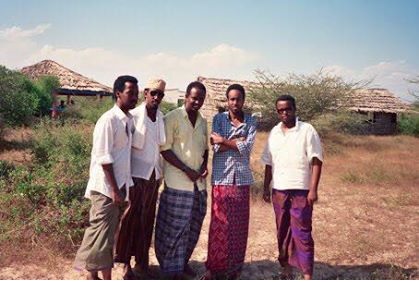
This was supposedly a short post and a hastily written one, triggered by these photos of Dr. Abdisamad with his older brother and his friends in Xaraf, Xamar 1988.
Dr. Abdisamad with his older brother and his friends in Xaraf, Xamar 1988.
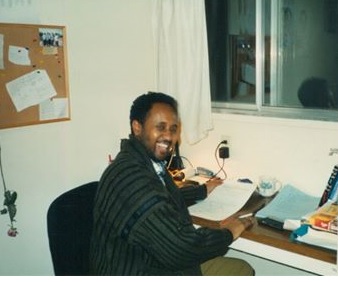
The esteemed Philosopher is a man who has been through many trials and tribulations. He’s been through the worst times/crises of his life by not only losing his beloved father but also a mentor who was a protector, a provider, a confidant and a very close friend. Looking closely at the board in the room (second photo) , there appears a picture of his friends at FIAT–a unique central meeting place that is an acronym for “Fabbrica Italiana Automobili Torino”, which, in English translates to “Italian Car Manufacturer of Torino.” Contrary to Ray Charles’ Georgia on My Mind song, instead, Dr. Abdisamad would have his friends on his mind.
Maybe, as an avid reader at a very young age, he must have read and taken it to his heart and maybe indoctrinated–if at all such things existed–and internalized it into his inner self, that childhood fable of The Bear and the Two Friends.
Here he vows in a whisper–a memo directed , if you will– to his own subconscious, and an indelible one that he will never abandon his friends and will always treat them with respect, dignity and love. Maybe that explains why from at an early age on and up to now with accomplished academic credentials and a steady job at Fortune 500, his touching sagacity continues to affect the lives of many of his friends.
A loving husband and father of three beautiful adorable kids, he seeks out and reconnects with friends, calls, talks, pays visit in faraway places, supports, gives advice, values their friendship, laughs carelessly, reminisces with them about the good old days in Mogadishu–a Mogadishu that was so vibrant and metropolitan in context. So cosmopolitan that it was dubbed the “Pearl of Africa.” Mogadishu, meaning the “Seat of the Shah” in Persian, was undoubtedly, a diverse, peaceful and beautiful city!
He indulges in having fun, good times and jokes with them, brings them together, such as when he arrives in Toronto; he brings together friends who live in the same city who otherwise would not have seen each other for years on end. He has an aura of charisma that surrounds him and which forever attracts others towards him, always extending his arm to shake and introduce himself, looking people in the eye, calling them by their first names once they get acquainted, listening to them attentively, giving his complete attention, thus perfecting that ancient clichés or wisdom of having two ears and one mouth is to listen more and speak less.
Dr. Abdisamad appears to be studying while at the same time grading papers/exams of other students in America 1992.
He is constantly making friends on the fly–new friends who will become his bosom friends for life. Simply put, he always inherently sees the good in people. His friends come in all shapes and forms and from social statuses that range from young shoe-shiners to adults detailing cars at FIAT. Add to that the nomads he met on his travels or those he meets in board rooms while transcending the contemptible and petty ‘isms that we tend to divide ourselves. They hail from every nook and cranny, every little hamlet and every region of Somalia.
Early Childhood
In the sprawling Hodan suburb at Jidka Soddonka, a new development is afoot, big open spaces, half-finished construction of rows of houses, and electrical transmission lines; some houses had electrical power, very few had telephone lines, no running water while most houses had “Fuusto”–a barrel/drum or water tank mounted at the top of the house for water use. Here, Abdisamad made a lot of friends. Rambunctious little kids ran here and there, played hide and seek in the open spaces, Katimeey katim and also “Bistoolo Bistooleey” which were similar to The Indian and Cowboygames; they played soccer barefooted, with Gocondho (Tribulus terrestris), Booc Booc (Calotropis procera) Qodax (thorns) common with Acacia species in abundance, friendship cemented for life.
He would gather them in his Family’s house and let them play board games with him, share his stuff…A prelude to what will happen in the future in their house in Shibis suburb.
A water tank truck brings fresh water to that neighborhood once every three or so days, especially to his family’s house, but one day he found out that some of his friends didn’t have water at all, there begun a quest to quench the thirst of his friends and their families. He would fill up a bucket of water, carry it and deliver it to his friends’ houses, one house at time. Skinny and lanky he was, he would fall down carrying the bucket at times by the sheer load of the water; trying ever so hard not to spill the water, he would get up and never relent until he delivered the life-saving precious little water container.
After the good Doctor had done this long ago…a bucket for a friend in need, there sprung up all kind of charities in Africa now, using the bucket to deliver water to those without BIYO (water).
Moving to Shibis
Adept at making new friends, Dr. Abdisamad saw more diverse and interesting neighborhoods, explored Bilaajo (from Italian vilaggio for village in English) Hoos Market, Bilaajo Kor, Khamiir Restaurants in Manaboolyo (monopoly), Caano San and then ventured into Cabdiasiis and Liido Beach. At times he went further afield to Shingaani and city center while making friends along the way.
In Shibis Hoose, he would bring in more friends with him at break time, but friends would come to his house without him as well, in a beehive like activity trekking in and out of the house during school hours; most would help themselves to cold water or homemade ice cream “Jalaato” (Italian gelato), from the fridge or would eat snacks and feel at home. This jovial and genuine affection for friends and others continued up to high School in Sakhawaddin and beyond.
Smart, studious, and disciplined, he excelled and shined at school. Well-mannered, extremely polite, and considerate in nature, he hardly created trouble at home. He had Adeer (uncle) Nur’s ear, so to speak. Adeer Nur Bidaar AUN loved his kids immensely and respected and welcomed their friends. As a gesture of goodwill, Uncle Nuur Bidaar facilitated visas, passports, and scholarships and even paid air travel tickets and other travel expenses to his children’s friends from his own meagre resources.
The trend of inviting his friends over continued, and their house was the perfect “Rendezvous Place” for eating capacious, succulent, finger-licking and delicious foods, or Casariye to die for which was served every day. It consisted of Sambosas, Bur, Daango or Salool and other goodies and Spiced Shaah with Milk or Qaxwa Xaraar and of course, the main attraction which was, watching videos of Soccer Tournaments, or NBA gamers mainly between the Lakers vs. Celtics, or my favorite…the selection of Pele’s wonderful goals and skills. Thanks in part to Abdisamad begging, pressuring and convincing his father to approach business people he was friends with and some in Somali Airlines to bring VHS videos from Italy right after the games were played in Europe.
I remember very vividly watching the entire World Cup of 1982 held in Spain at their house. The noise, the clapping or shrill shouts had at times reached at a gradually ascending pitch crescendo. I would imagine it must have been unbearable for his family. Most of us that year rooted for Brazil, but was beaten by Italy in the quarterfinals 3-2. Paolo Rossi screwed us up by scoring all the 3 Italian goals. Also in 1988, we watched the entire European Champions won by The Netherlands, Ruud Gullit, Van Basten, Rijkaqrd and Koeman as we dubbed him Tima cadde or as some would say “tima cadde najis najis dhalay.” When a team visited the capital from other countries, we would run to him for a guest pass at Lujino, Conis or Mogadishu Stadium, or we would implore him to get some tickets for us.
“A good friend is like a four-leaf clover; hard to find and lucky to have.”
This was supposedly a short post and a hastily written one, triggered by these photos of Dr. Abdisamad with his older brother and his friends in Xaraf, Xamar 1988.
Dr. Abdisamad with his older brother and his friends in Xaraf, Xamar 1988.
The esteemed Philosopher is a man who has been through many trials and tribulations. He’s been through the worst times/crises of his life by not only losing his beloved father but also a mentor who was a protector, a provider, a confidant and a very close friend. Looking closely at the board in the room (second photo) , there appears a picture of his friends at FIAT–a unique central meeting place that is an acronym for “Fabbrica Italiana Automobili Torino”, which, in English translates to “Italian Car Manufacturer of Torino.” Contrary to Ray Charles’ Georgia on My Mind song, instead, Dr. Abdisamad would have his friends on his mind.
Maybe, as an avid reader at a very young age, he must have read and taken it to his heart and maybe indoctrinated–if at all such things existed–and internalized it into his inner self, that childhood fable of The Bear and the Two Friends.
Here he vows in a whisper–a memo directed , if you will– to his own subconscious, and an indelible one that he will never abandon his friends and will always treat them with respect, dignity and love. Maybe that explains why from at an early age on and up to now with accomplished academic credentials and a steady job at Fortune 500, his touching sagacity continues to affect the lives of many of his friends.
A loving husband and father of three beautiful adorable kids, he seeks out and reconnects with friends, calls, talks, pays visit in faraway places, supports, gives advice, values their friendship, laughs carelessly, reminisces with them about the good old days in Mogadishu–a Mogadishu that was so vibrant and metropolitan in context. So cosmopolitan that it was dubbed the “Pearl of Africa.” Mogadishu, meaning the “Seat of the Shah” in Persian, was undoubtedly, a diverse, peaceful and beautiful city!
He indulges in having fun, good times and jokes with them, brings them together, such as when he arrives in Toronto; he brings together friends who live in the same city who otherwise would not have seen each other for years on end. He has an aura of charisma that surrounds him and which forever attracts others towards him, always extending his arm to shake and introduce himself, looking people in the eye, calling them by their first names once they get acquainted, listening to them attentively, giving his complete attention, thus perfecting that ancient clichés or wisdom of having two ears and one mouth is to listen more and speak less.
Dr. Abdisamad appears to be studying while at the same time grading papers/exams of other students in America 1992.
He is constantly making friends on the fly–new friends who will become his bosom friends for life. Simply put, he always inherently sees the good in people. His friends come in all shapes and forms and from social statuses that range from young shoe-shiners to adults detailing cars at FIAT. Add to that the nomads he met on his travels or those he meets in board rooms while transcending the contemptible and petty ‘isms that we tend to divide ourselves. They hail from every nook and cranny, every little hamlet and every region of Somalia.
Early Childhood
In the sprawling Hodan suburb at Jidka Soddonka, a new development is afoot, big open spaces, half-finished construction of rows of houses, and electrical transmission lines; some houses had electrical power, very few had telephone lines, no running water while most houses had “Fuusto”–a barrel/drum or water tank mounted at the top of the house for water use. Here, Abdisamad made a lot of friends. Rambunctious little kids ran here and there, played hide and seek in the open spaces, Katimeey katim and also “Bistoolo Bistooleey” which were similar to The Indian and Cowboygames; they played soccer barefooted, with Gocondho (Tribulus terrestris), Booc Booc (Calotropis procera) Qodax (thorns) common with Acacia species in abundance, friendship cemented for life.
He would gather them in his Family’s house and let them play board games with him, share his stuff…A prelude to what will happen in the future in their house in Shibis suburb.
A water tank truck brings fresh water to that neighborhood once every three or so days, especially to his family’s house, but one day he found out that some of his friends didn’t have water at all, there begun a quest to quench the thirst of his friends and their families. He would fill up a bucket of water, carry it and deliver it to his friends’ houses, one house at time. Skinny and lanky he was, he would fall down carrying the bucket at times by the sheer load of the water; trying ever so hard not to spill the water, he would get up and never relent until he delivered the life-saving precious little water container.
After the good Doctor had done this long ago…a bucket for a friend in need, there sprung up all kind of charities in Africa now, using the bucket to deliver water to those without BIYO (water).
Moving to Shibis
Adept at making new friends, Dr. Abdisamad saw more diverse and interesting neighborhoods, explored Bilaajo (from Italian vilaggio for village in English) Hoos Market, Bilaajo Kor, Khamiir Restaurants in Manaboolyo (monopoly), Caano San and then ventured into Cabdiasiis and Liido Beach. At times he went further afield to Shingaani and city center while making friends along the way.
In Shibis Hoose, he would bring in more friends with him at break time, but friends would come to his house without him as well, in a beehive like activity trekking in and out of the house during school hours; most would help themselves to cold water or homemade ice cream “Jalaato” (Italian gelato), from the fridge or would eat snacks and feel at home. This jovial and genuine affection for friends and others continued up to high School in Sakhawaddin and beyond.
Smart, studious, and disciplined, he excelled and shined at school. Well-mannered, extremely polite, and considerate in nature, he hardly created trouble at home. He had Adeer (uncle) Nur’s ear, so to speak. Adeer Nur Bidaar AUN loved his kids immensely and respected and welcomed their friends. As a gesture of goodwill, Uncle Nuur Bidaar facilitated visas, passports, and scholarships and even paid air travel tickets and other travel expenses to his children’s friends from his own meagre resources.
The trend of inviting his friends over continued, and their house was the perfect “Rendezvous Place” for eating capacious, succulent, finger-licking and delicious foods, or Casariye to die for which was served every day. It consisted of Sambosas, Bur, Daango or Salool and other goodies and Spiced Shaah with Milk or Qaxwa Xaraar and of course, the main attraction which was, watching videos of Soccer Tournaments, or NBA gamers mainly between the Lakers vs. Celtics, or my favorite…the selection of Pele’s wonderful goals and skills. Thanks in part to Abdisamad begging, pressuring and convincing his father to approach business people he was friends with and some in Somali Airlines to bring VHS videos from Italy right after the games were played in Europe.
I remember very vividly watching the entire World Cup of 1982 held in Spain at their house. The noise, the clapping or shrill shouts had at times reached at a gradually ascending pitch crescendo. I would imagine it must have been unbearable for his family. Most of us that year rooted for Brazil, but was beaten by Italy in the quarterfinals 3-2. Paolo Rossi screwed us up by scoring all the 3 Italian goals. Also in 1988, we watched the entire European Champions won by The Netherlands, Ruud Gullit, Van Basten, Rijkaqrd and Koeman as we dubbed him Tima cadde or as some would say “tima cadde najis najis dhalay.” When a team visited the capital from other countries, we would run to him for a guest pass at Lujino, Conis or Mogadishu Stadium, or we would implore him to get some tickets for us.
Today I went downtown Karisa to pick up Eidd stuff for my children. After strolling for a while through the congested streets, finally, I ended up at Soko Mjinga aka Suuq Mugdi. Walking with a business lady I was to seal a business transaction, we evaded men pushing heavily loaded wheelbarrows, mkokotenis, ladies in Wahhabi attires, men in Kanzu, and rambunctious kids on their mid-term break.
The market is a haven for Garoobs selling various types of clothing, noisy hawkers from down Kenya, pickpockets, men in Qaadiro stages, reggae ragamuffins, ilbax-shaarres, braggadocios, youngsters devastated by the agonizing buufis, business magnates, decayed slatterns, mentally retarded youth, toothless baagamuundos, learned men and women and people of scary features.
Suuq Mugdi is the Wall Street of this historic town that is populated mainly by people of Somali decent. The general infrastructure resembles a makeshift camp (iska deg), the streets are horrifically narrow and nauseating especially the rainy season, while the entire scene is evocative of an IDP camp.
Regardless of its shape and appearance, it is a daily meeting place for the beautiful and the beastly human and of course, unbeknown to many, beneath the infrastructure, a resting place for saintly men who departed for the Afterlife before the markets' initial foundation. It is a Cafe Internazionale where when ten people meet for a conversation, nine talk and only one listens. It is a paradise for those who love to chatter like Orang Utans (upright man).
Almost all the products sold here have been imported. The only eye-catching Somali-made products are uunsi, alindi or al-Hindi ladies wear and idin or idan for burning frankincense. Everything else is foreign with Chinese products taking the lead. But wait, Kenya made products are plentiful here. In case you want to sharpen your Somali sword or spear such that the end product meticulously appears sharper than the Wilkinson Sword and Nacet blade combined, purchase a Jua Kali made utensil, get hold of any kind of seeds or grab a kilo of buunsho for your starving donkey, Soko Mjinga has it all.
This place is where supply and demand meet. Adept at selling and bargaining, you will never be discouraged when buying from a Waryaa. The place, regardless of its austere simplicity, design and shape, is a monumental economic giant second only to Nairobi's Somali dominated Eastleigh.
Should you leave this place discouraged for failure to wrest control of what you desire most, let it even be a woman of your choice, I can bet you have not gone into the unexplored depths of this majestic but monstrous market that harbors products beyond human imagination.
The Egyptians during the succession of Pharaonic dynasties could not pronounce the letter 'cayn' in the Arabic alphabet and so they called their god Ra. A famous god they worshiped was called Amen Ra during the Theban Supremacy.
Somalis are a Cushitic people whose past history should not be taken lightly because Cushitic history predates Egyptian history. Before the introduction of writing, oral history had the upper hand in historical narrative.Brushing aside Somali genealogy is tantamount to historical deletion and a way of abandoning the beauty and existence of a unique race that left behind unique footprints worth pondering. Blindly believing in everything written by other races who denounced anything black is a gross miscalculation.
Where god was Raac in the Cushitic language, the Greek and Egyptian tongues could not pronounce the Cayn mentioned earlier. It is also worth mentioning that the Somali language itself has been undergoing changes for millenniums. However, we can get from other Cushitic languages what had been lost in Somali since these languages are identical in context.
The sun would have been Qoor Raac as in one particular African ethnic group that is very close to the Somali as both share linguistic and cultural similarities but not religious identity. The term Qoor Raac which is in reference to the sun means 'the overseer god who watches over us using his neck' or if you speak Somali it would mean, 'ka qoorta nala raaca ama na qooraansada'.
It has been estimated that the Somali language contains over 2,000 words of Hieroglyphics. In Somali, gowrac denotes to slaughter while in that unique language mentioned above it is Goy Raac which translates to 'cut or slaughter in honor of Raac'. So, Gooy Raac was and is a form of sacrifice to the god who is/was Qoor Raac or the overseer.
In conclusion, I find it outlandish for people who are revered in the West to demonize Black Africa by giving people of White color leverage over other races. Inconsequential articles and utterances by notable White figures laden with derogatory languages denigrating the African race must not be taken lightly. Arnold Toynbee, one of the most celebrated historian rebuked the black race for not making any “creative contribution” to the cause of civilization. Likewise, the demeaning tongues of Winston Churchill, Theodore Roosevelt, and Stuart Mills among others, were nothing but propaganda techniques meant to elevate eurocentrist thoughts and a harbinger for advancing their wanton practices.
While Karisa is already bleeding from poor containment of the dreaded black plastic bag that has become a nuisance everywhere and the plastic water bottle locally known as Gajacleey wrecking havoc on the environment, another dangerous scenario has evolved and that is the proliferation of political posters on billboards that have added insult to an already incurable existing injury.
Strewn everywhere by careless shoppers, for a long time, the common black shopping bag has been silently killing stray livestock that consume it on a wider scale. Known as Iskoris for their adeptness and survival tactics without owner's upkeep, cows, goats and sheep eventually suffer strangulation and instantaneous deaths.
Almost all of the commercial billboard advertisement messages have been replaced by political posters displaying photographic images and logos of potential candidates for the anticipated August general elections. With competition rising among competing political forces, a keen observation of poster displays reveal appalling political savagery never experienced before in this human forsaken town devastated by tribal sentiments since the introduction of multiparty democracy in Kenya.
Poster disfiguring, replacements by way of ripping off opponent posters, spray painting to taint images, or paste on top techniques have given hired hooligans a field day. This is sheer political hooliganism that is growing roots everywhere. Solar and electric light poles have not been immune either. Surprisingly, a poster that has been posted today, will not survive tomorrow. This form of jungle politics is contrary to modern democratic norms of political publicity.
Since we are vicegerents of the Creator Who entrusted with us a clean earth for our use, how dare we behave like animals having inferior faculties of thinking? No matter how many posters you display or destroy, one thing is clear: 8/8/2017 voters have already made up their minds and know who to vote for on that material day.
The first
British colonial settlement in Garissa district was at a place called Mansabubu
at the beginning of the nineteenth century, as recollected by Sultan Deghow.
Fed by the meandering Tana River–a river that is 1,000km long and trickles from
the Aberdare Mountains in central Kenya and drains near Kipini, the first colonial
settlers were brought to Mansabubu by Sultan Sambul, Deghow’s grandfather, from Lamu that is located along Kenya’s maritime
coast bordering Somalia. Regardless of Omani Arabs having heavy presence along
the Eastern Africa coast, the British had the mandate to traverse the Indian
Ocean because, though preceded by an agreement with the United States in 1833,
the Sultanate of Zanzibar had signed treaties with European Powers such as
France in 1862 and Germany in 1886 respectively. However, it was the 1886
agreement that made the Sultanate’s sovereignty unchallenged.[i]
With competition
rising among the European powers on how to expand their influence in Africa, the
British administrators felt it was time to venture into the hinterlands. As
explained by Nene Mburu, Sultan Stamboul (Sambul), was a fully recognized
traditional elder of the Ogaden clan–a man who was in the third generation
among the Somalis who settled in NFD–and so was the Borana Chief Haji Galma
Dida who was the son of Dida Dayo–a senior chief who was the overlord of Wajir
during the British Colonial Administration.[ii]
By 1923 after the death of Dida Dayo and the coronation of his son, the
territorial stretch of Borana land
that previously included Wajir, Garbatulla, Isiolo and
Marsabit was subsequently reduced after Somali scuffles with the Borana
resulted in the Borana being pushed westward, as Mburu maintains.
There have been long
and simmering tensions between the Borana and Somali over land accumulation for
centuries with the Somali using sheer force to evict the Borana from their
ancestral lands. Cattle rustling were other factors that contributed to tribal
altercations. With their herds of livestock, Somalis have been in search of
greener pastures and getting closer to the Ewaso Nyiro River would have been a
natural delight. Though not a perennial water source that flowed permanently
year-round, it was a temporary river that nourished the Borana and Samburu
ethnic groups for years. Despite that, for Somalis, access to this water source
would have been a natural resource that would give relief to their large herds
and sustain human life. Somalis have long had a history of migration, and the determination
to conquer new territories either from rival Somalis or from other stable
ethnic groups such as agro-pastoral groups and hunters and gatherers living in
thriving dense forests. Likewise, having been adept at the psychology of assimilation,
no wonder, and conflict has been a thriving factor[iii]
in their pastoral economy. As a superpower in their areas of influence at that
time, it boggles the mind how Somalis emulated the psychology of warfare–a
political trend that is practiced by modern superpowers of today, that war
spurs the economy, reduces unemployment, and creates new opportunities while
raising the rating of the leader only when victory is achieved over the rival
enemy.
To further
define the abstraction of Somali assimilation, the term implies intermixing,
intermingling, integrating, incorporating, and amalgamating with other Somali
clans or sub-clans or with other ethnic groups or allowing slaves and those
seeking safety to be part of the Somali clan realm. However, not all Somali
clans practiced the notion of assimilation. No wonder, according to popular
opinion, the Ogaden that is part of the greater and populous Daarood clan are
the most tolerant and welcoming of other besieged and mortified Somalis. In
fact, many Somalis who are familiar with the Somali culture attest to the fact
that the Ogaden exemplify a political organization where one can be a member of
the clan, marry from, pay diya or mag (blood money) and quit when necessary.
The connotation Sheegad, which many
writers or researchers define as ‘pretenders’ could have been better
interpreted as ‘to claim’, ‘be part of’ or be a ‘claimant’. Somalis living in
northern Somalia regard the name Sheegad
as dishonorable while in northern Kenya, it has been acceptable in the past.[iv]
British Colonial
Chieftainship
The British
creation of chieftainship in later years among the tribes that had strength and a strong presence in the former NFD was a means
to usher in indirect rule–a political subterfuge defined in later years as a ‘divide and rule
tactics’. The creation of imaginary lines by the colonial powers came to define
geographical boundaries that would serve as maritime and specifically defined
landmarks by their own surveyors, which in the end placed a wedge between
people of close consanguinity. The covetousness of the colonial powers and
their mistreatment of the black race were beyond divinely guided, rightly
thinking human comprehension. It is the same land and maritime demarcation that
is the source of contention among many African nations to this day. Intra and
inter-state wars continue to undermine the way forward to progress for many
Africans whose leaders were drawn from the legacies of colonialism.
At that time in
history, in Wamo, an expansive land that stretched from Kismayu in southern Somalia
and into some parts of Kenya’s Northeastern region, there were internecine wars
among the various Ogaden sub-clans. With no reconciliation in sight and the
prospect of peace and stability diminishing, and hunger and deprivation
skyrocketing, some of the sub-clans decided to disperse to various destinations equal in enormity to a phenomenon in the
year 1937–a
perilous era Somalis dubbed ‘Sannadkii kala
Carar’[v]
which translates to the ‘Year of Pandemonium’. In that same year–1937–Somalis
experienced abundance of milk and therefore they named it ‘Sannadkii Caana
Arag.’ There was an outbreak of locust invasion in 1935, meaning
Somali-inhabited areas or forcefully captured lands have been prone to natural
disasters in the 19th century and beyond.
Defining Afmadow
The main
headquarter of the Ogaden clans before the Abdwak clan bid the rest goodbye, was
a small settlement called Afmadow (Afmadu in English) in the middle of the current
Lower Juba Valley of southern Somalia. Almost 110 kilometers (68 miles) from
the Port City of Kismayu[vi],
Afmadow cherishes to have a long history. The settlement had no reliable water source
before Somali migration to the region. However, it had had a hundred and
fourteen boreholes when the British Colonial Administration finalized the
digging of water catchments and water wells in 1944–a year before the Second
World War ended. This era is known as “Sannadkii Dhul Qod” in Somali which
translates to ‘the introduction of dams’ and coincides with the Ogaden subclan
Mohamed Zubeir and Bartire War.
Somali oral
historians attribute Afmadow to have been the name of an Orma, Oromo, or Wardei
woman while others give credit to a Somali woman. Both narratives will be taken into context. Once upon a time, the
Talamogge and another Ogaden sub-clan decided to fight on a certain day and the
venue would be under an acacia tree within Afmadow periphery. However, the war
never materialized due to reconciliations among elders. Regardless, unaware
that the war had been halted, a few warriors came to the designated
battleground dressed in full battle gear. Instead, they found a dark-mouthed
non-Somali girl. Thus, was born the name Afmadow.
In another
narrative, at a time of immense suffering due to water shortages where people
and their livestock were dying whole scale, a renowned Saint came up with a
startling proposition. He proposed that the most decent, blameless, and
untarnished woman–a woman of unspoiled character who is loyal to her husband to
be brought before a convention of elders. People got bewildered, baffled,
surprised, and appalled at the saint’s feigned premise. With mouths agape,
wide-eyed, and able hearing ears directed at the saint’s announcement, a man
from the Asharaf clan who lived among the Ogaden and was married to a woman
whose name was Afmadow, raised his hand and promised to turn over his wife. After
being handed over, the saint commanded the woman to undress before her husband
in full view of the conveners. When she was about to untie the figure of
eight knot known to Somalis as Gareys or Garxir, he yowled at her to stop her indecent actions and fasten
the knot. Instead, he gave her a spear and told her to dig between her feet
exactly where she was standing. Immediately she hit the ground with the double-edged
sharp spear–a spear that was sharper than Wilkinson Sword and Nacet Blade
combined, a fountain of water from the Ewaso Nyiro River that runs underground
started to sprout up like the Yellowstone Fountain of the U.S. in the state of
Wyoming.
Thus, the name
Afmadow (Dark Mouth)–an indication of beauty–is derived from the name of a
woman from the Rer Mohamed sub-clan. Mohamed was the uncle of the Abdalla
sub-clan who are collectively known as Samawadal.[vii]
The two sub-clans have a great presence in the towns of Ijara and Masalani that
are part of Garissa County. Samawadal and Abdiwak are cousins and are together
called Talamogge. The Samawadal and Abdiwak have always lived together in
peace, sharing water and pasturage, going to war as one entity, and engaging in
intermarriages, though, at times, they would fight among themselves. However,
in case of altercations, problems would be solved through the application of
customary laws known as “Xeer”, where the elderly would deliberate under the
shadow of a tree and finally come to conclusions.
Leaving no stone
unturned, the Abdiwak Sultan in Afmadow, sensing impending dangers related to
war, famine and drought, and diseases and death, sent his own two surveyors
known as Sahan to search for water. After a month of absence they arrived at a
place close to Sankuri known as Daloolo where their sights caught a mighty
flowing River. On inquiring from the inhabitants who were mostly of the Wardei
ethnic group–the same community who were evicted by the Somalis from southern
Somalia, they were told it was called Ganana Maro. Rejoicing at the sight of
the river, the two surveyors, after being hosted by the Wardei, set off to
return to Afmadow. On returning to Afmadow, the two surveyors returned to the
king with the goods news that caused jubilation among his subjects and consternation in others. It was here Abdiwak and their fellow
kinsmen took the extraordinarily extensive trek of retracing the footsteps of
the previous land examiners.
The forward trek to unknown destinations was never a free
ride to a land of opportunities as it bore painful repercussions
and beautiful fruits. The regions ahead were either devoid of humans, empty and isolated or
heavily populated by formidable, irreconcilable and irrepressible men who
fought tooth and nail to defend their territorial integrity from outside
aggression and multitudes of ferocious and cunning wild beasts that devoured
livestock and man at will. Regardless
of the death and destruction encountered en route, the forward push to greener pastures
materialized for the king and his followers–a heroic act of manhood later on to
be emulated by other Ogaden sub-clans after the dust had settled. With most
African tribes and wild beasts eventually subdued by the successive kingdoms of
Abdiwak, it was time for rehabilitating the surviving, captured antagonists and
a time for recuperation, reproduction and forging alliance with the most volatile
of all humans–the Whiteman.
[i]Mwaruvie, John. "The Ten Miles Coastal strip: An
Examination of the Intricate Nature of Land Question at Kenyan Coast."
(2011).
[ii]Mburu, Nene.Bandits
on the border: the last frontier in the search for Somali unity. Red Sea Press,
2005.
[iii]Farah, Ibrahim, Abdirashid Hussein, and Jeremy Lind.
"Deegaan, politics and war in Somalia."Scarcity and Surfeit. Institute for
Security Studies. Pretoria, South Africa(2002):
320-356.
[iv]Schlee, Günther.Identities
on the move: clanship and pastoralism in northern Kenya. Vol. 5. Manchester
University Press, 1989.
How many powerful queens and kings have come and gone and will never return to us? Where is the Pharaoh who claimed to be god? You will tell me he was drowned and that his body has never been found. You're wrong. His corpse was retrieved from the salty water, was embalmed and preserved in a sarcophagus and he will remain in that state until the Day of Resurrection for humanity to see.Go to Egypt and visit the pyramids. He is there. Where are his two famous confidants, Ammon (Haamaan) and Korah (Qaaruun)? Despite being dead, they are being tormented.
Tell me, where is the powerful Nimrod? If you believe in Charles Darwin's 19th century Theory of Evolution, why not believe in past revealed books and the Grand Qur'an that has been perfected and protected by Allaah, The Beneficent, The Merciful?
How many transgressing generations were destroyed by fiery winds, deafening blasts, deluge, violent earthquakes, hell spewing volcanoes, furious hurricanes, gales, typhoons and tornadoes and will never return to this world?
What do you know of what is happening to the occupants of the graves some of who are in deep slumber and others burning and suffocating till the Day of Resurrection?
Don't you understand the contents of the Qur'an? Don't you see? Don't you reflect? Don't you ponder? Don't you hear?
Take a heavenward flight approximately 12 miles fixedly for 8-hours, then return to earth. You will not land at your previous departure point because the earth has moved.
How comes the earth is suspended, revolving and rotating day and night, yet all the oceans and rivers don't spill over? By the Power of Allaah, the mountains are stakes.
Imagine a veil is removed from your eyes and instantaneously your new vision is exposed to new creatures you have never seen or imagined before. Would you be terrified or amused by their sight?
Can you recollect when you were in your mom's womb and the stages you've been through?
If you will agree with me that you were formed from liquid, then how can you dispute with me creation without a father or creation from clay without a father and mother to be impossible?
We calculate the distance of stars from earth by light years. Yet, they are a decoration for the lower heaven and ease of navigation for you. So, imagine what is above them?
Why do we have different times and not a universal one?
We have eyes, ears and brains, but there are those who are deaf, dumb and blind because they have diseases in their hearts and The Creator has increased for them the diseases afflicting their faculties of thinking.
Don't tell me The Creator has partners, that there are two gods or many gods. How could these gods agree on power sharing if humans cannot?
There is only One Creator and His Name is Allaah. His name was in the Psalms (Zaboor) of David (Da'ood), the Torah (Tauraat) of Moses (Moosa) and the Evangel (Engeel) of Jesus (Eesa), but were deliberately deleted by men. The messages that were contained in those books have not been lost and are still with us up to this day without adulteration. They have been incorporated into and preserved in the Only Living Testament-the Qur'an that was revealed to Muhammad, the Seal of the Prophets (Peace and Blessing of Allaah Be Upon Him).
Ibn Kathir and the early scholars of Islam state that the Ten commandments are reiterated in two verses from the Quran.
“Come, I will recite what your Lord has prohibited you from, Join not anything in worship with Him; be good and dutiful to your parents; kill not your children because of poverty- We provide sustenance for you and for them; come not near to shameful sins whether committed openly or secretly; and kill not anyone whom God has forbidden, except for a just cause. This He has commanded you that you may understand. And come not near to the orphan’s property, except to improve it, until he or she attains the age of full strength; and give full measure and full weight with justice. We burden not any person but that which he can bear. And whenever you give your word (i.e. judge between men or give evidences) say the truth even if a near relative is concerned, and fulfil the Covenant of God. This He commands you, that you may remember.” (Quran 6:151-152)
Nowadays, a look at how some of the Somali youth living in the Western Hemisphere prepare for their future upon graduating from high school is cause for alarm. By developing distorted mental imaginations, these youth who hail from disadvantaged backgrounds and broken families, find it difficult to heed the advises given by their school counselors because of preconceived established ideas ingrained in their minds that are hard to alter. Ironically, with falling school performances reported among school-going Somali children in Europe and North America, choosing the wrong careers after the gates of the schools are kept under lock and key create unease for any watchful educator and parent who wishes to see all kids remain in school until they are capable of handling their affairs. Even with plenty of financial aid and other grants available and reserved for those willing to partake in the furtherance of their education, the prospects of remaining in school diminishes for reasons best known to them.
Because of their obsessions with immediate jobs and some cash to propel them in to the murky waters of the underworld, these kids end up taking up menial jobs and often find themselves shoved in to contemptible and unprofessional fields like cab driving, janitorial, doormen, cooks, and the manufacturing industry considered to be the lowest paying in terms of job classifications. However, because of overabundance of narcotics and other mind altering drugs readily available in the streets, tardiness and ill-fated temptations usher them in to the corridors of social rejection and disobedience that ultimately lead them to rub shoulders with the law.
Thus, the youth who was touted to be a shining star unto himself, his family, and his nation, becomes a subject of condemnation when an unpardonable and strange act leads him to the gallows of a dreaded prison. Though many strait-laced, fortunate convicts who serve their sentences cautiously emerge out of the gates of dungeons with rosaries in hand as signs of repentance, the hard core ones who remain behind could find themselves rewarded with extended jail terms due to other horrible felonies committed while behind bars. Such sarcastic miscalculations in life may be attributed to poor parental and societal upbringing, lack of role models and mentors, resettling with careless and unfamiliar faces and families, failure to grasp the exhortations of the elderly, and taking the wrong path in life.
Also, the effects of the horrendous civil wars that separated family and friends, child abuse and neglect, familial indiscipline, parental drug addiction and illiteracy, abject poverty, and hordes of imperfections content in the social fabric they live in become the driving levers for their self-immolation or self-destruction. In addition, the social depravity of the host environment and the guest youth’s competition for space and recognition coupled with the desire to assimilate opens a path for unintended social interactions and exposure to malignant, apathetic, and alien cultures that easily consume the diminutive empathy exported from country of origin.
Furthermore, the harboring of a sense of inferiority by the novel guest and the ardent desire to participate in the affairs of the newly exposed locale tremendously alters, defaces or may even erase whatever little was left of his brain chemistry. The once exotic youth finds themselves immersed in an unfathomable bottomless pit commandeered by criminals of the most awful category. Societal fragmentation in the Diaspora, lack of extra-curricular activities, exposure to pornography, cinematographic obscenities, and lack of parental involvement in Parent Teacher Associations, are the deriding factors behind the collapse of the once youthful Somali Empire.
The stubborn outgrowth of filaments of animosity and the division of society along clan lines has never been so profound in Somali society before. While it is true that poor governance, foreign interference in Somali affairs, and lack of reconciliation between warring factions added to Somali calamity, what we should note with dismay is how the Diaspora’s disregard for unity and coherence culminated in the breakup of many who cherished trust, love, and unanimity in matters exclusive to the Somali people and nation.
The handouts and welfare benefits provided by the host nations to Somali societies and individual families are the main arteries that finance malevolent designs and the major propulsion engine of hatred in the Diaspora and in beleaguered Somalia. Wired via electronic remittances to Somali antagonistic forces on a monthly basis, these monies could be used to rejuvenate the education of Somali youth in the Diaspora and also those in impoverished Somalia.
While the number of Somali youth lagging behind bars in the Western Hemisphere could run in to the thousands, still there are an equal number of law abiding, sagacious, and hard working youth struggling to go beyond permanent barriers, travelling the hard road to prosperity, and effecting change by transforming the impossible in to the possible.